
Rebar Coupler Supplier in Dubai and the UAE
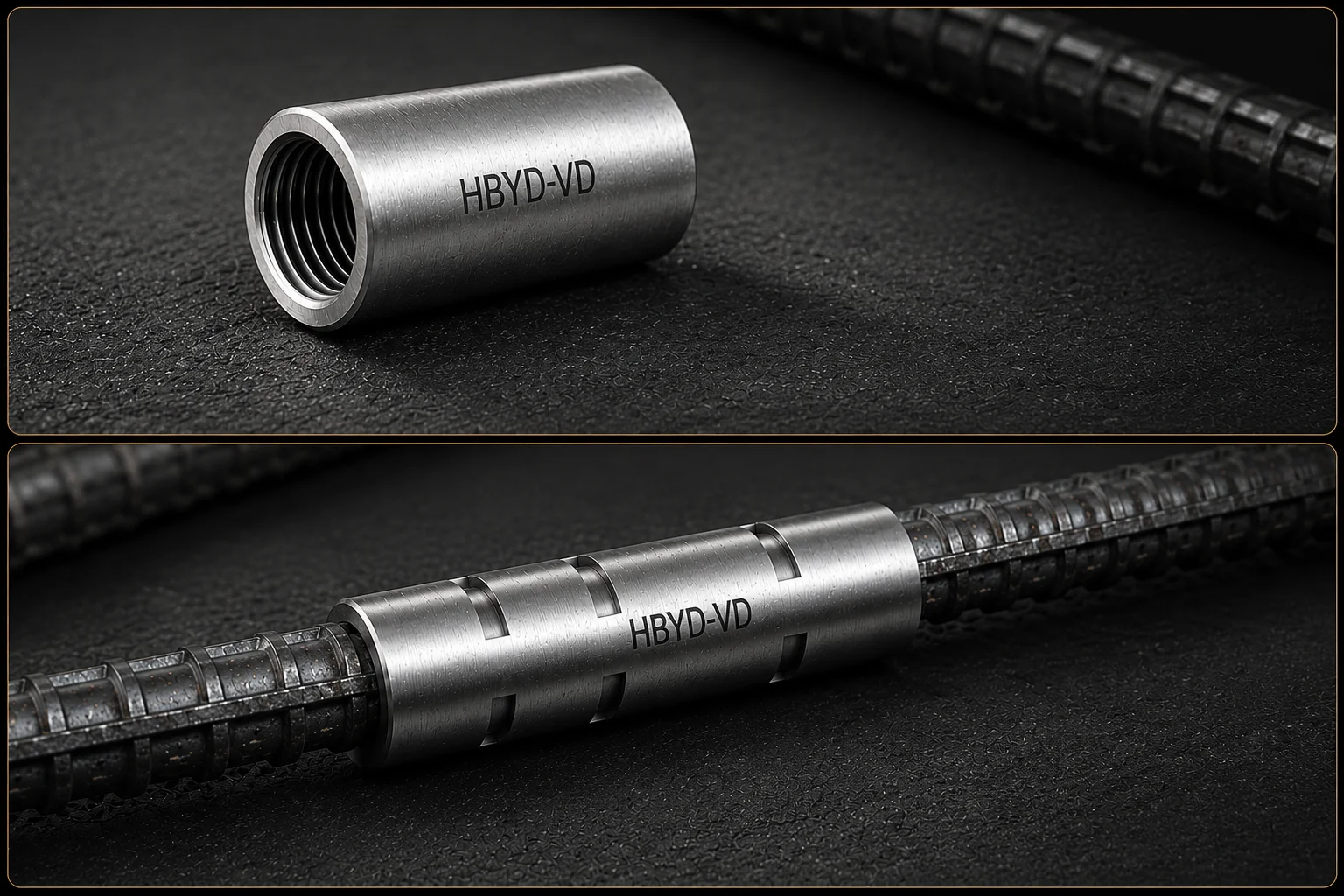
Veloce Dynamic supplies, fabricates, and installs mechanical rebar couplers (HBYD-VD) across Dubai, Abu Dhabi, Sharjah, and the United Arab Emirates. Our mechanical rebar splicing systems are engineered to replace lap splicing, providing structural engineers and civil contractors with a ductile, reliable, and cost-effective connection for columns, shear walls, raft foundations, bridge piers, and high-rise structures.
Our coupler portfolio features cold-upset parallel threaded couplers, straight threaded couplers, and hydraulically pressed (swaged) couplers covering all standard diameters from 16 mm up to 40 mm. By cold-upsetting the bar ends prior to threading, the cross-sectional thread root area remains larger than the nominal bar area, guaranteeing that tensile failure under ultimate load occurs in the reinforcement bar itself rather than at the connection (bar-break performance).
Backed by on-site automatic threading lines capable of producing 120+ threads per hour, experienced technicians, and comprehensive QA/QC submittal records, Veloce Dynamic delivers turnkey coupler packages that accelerate pour cycles and resolve reinforcement congestion on demanding civil projects.
Project Quality & Traceability Records
Verify equipment calibration records, batch test certificates, and operator qualifications in real time through our dedicated verification portal.
Available Rebar Diameters
Traceability & QA
- HBYD-VD permanent embossed marking
- Bar diameter and batch heat number traceability
- Compliance with ISO 15835-1:2018 and BS 8110 criteria
- Third-party laboratory tensile & slip test records
Scope of Services
- Coupler supply across 16 mm–40 mm diameters
- On-site automatic bar-end cold upsetting and threading
- Trained & certified installation technicians
- Calibrated torque verification & QC logging
- Independent third-party laboratory testing coordination
Key Applications
- Column and core-wall continuous reinforcement
- Deep raft foundations and pile-cap splices
- Diaphragm walls and high-density civil cages
- Bridge piers, abutments, and seismic frames
- Phased construction starter bars & extensions
Need Coupler Sizing or Quotation?
Our engineering team provides technical submittals, load calculations, and site trial demonstrations across Dubai & UAE.
Coupler Systems & Types
Upset Forged Threaded Coupler
The premier mechanical connection for high-rise and heavy infrastructure. Cold upsetting enlarges the rebar end before parallel threading, ensuring 100% bar break failure under tensile loads.
Straight Threaded Coupler
Efficient parallel-threaded mechanical coupler designed for standard reinforcement bar splicing where bar rotation is permitted during cage assembly.
Pressed / Swaged Coupler
Seamless steel sleeve connection installed using high-pressure mobile hydraulic swaging equipment. Zero threading or bar rotation required, ideal for congested repairs and starter bar extensions.
Transition & Positional Coupler
Engineered mechanical splices designed to join unequal bar diameters (e.g. 40mm to 32mm) or bridge reinforcement cages where neither bar can rotate.
HBYD-VD Mechanical Rebar Coupler Technical Specifications
Dimensional data and tensile performance criteria for Grade B500B / ASTM A615 Grade 60 reinforcement steel.
| Bar Size (d) | Coupler Outer Diameter (OD) | Coupler Length (L) | Thread Pitch (P) | Splice Failure Mode | Tensile Capacity |
|---|---|---|---|---|---|
| 16 mm | 26 mm | 45 mm | 2.0 mm | Bar Break outside connection | > 125% of yield strength (Type 2) |
| 20 mm | 31 mm | 50 mm | 2.5 mm | Bar Break outside connection | > 125% of yield strength (Type 2) |
| 25 mm | 38 mm | 60 mm | 2.5 mm | Bar Break outside connection | > 125% of yield strength (Type 2) |
| 32 mm | 48 mm | 70 mm | 3.0 mm | Bar Break outside connection | > 125% of yield strength (Type 2) |
| 40 mm | 58 mm | 85 mm | 3.0 mm | Bar Break outside connection | > 125% of yield strength (Type 2) |
Rebar Mechanical Coupler vs. Traditional Lap Splicing
Technical and economic analysis for structural concrete projects.
| Engineering Parameter | Veloce Dynamic Rebar Coupler | Conventional Lap Splicing |
|---|---|---|
| Steel Consumption & Waste | Zero lap overlap needed; reduces reinforcement steel consumption by up to 25%–30%. | Requires 40d to 50d lap length overlap, dramatically inflating steel tonnage and cost. |
| Bar Congestion & Concrete Compaction | Maintains uniform single-bar profile; allows aggregate to flow freely without voids or honeycombing. | Doubles bar concentration in splice zones; causes severe congestion and concrete consolidation defects. |
| Structural Load Transfer | 100% direct mechanical load path in both tension & compression, unaffected by concrete degradation. | Relies entirely on concrete bond stress; bond failure causes abrupt structural slip. |
| Seismic Ductility (ACI 318 Type 2) | Full ductile behavior tested under cyclic tension-compression to ISO 15835-1. | Prohibited or severely restricted in potential plastic hinge zones due to brittle debonding. |
| Crane Handling & Pour Cycles | Lightweight cages with fewer bars allow faster crane lifts and accelerated construction speed. | Heavy, congested cages require extensive tying labor, slowing down cycle times. |
Installation & Quality Control Workflow
End Squaring & Cutting
Rebar ends are cut perpendicular to the longitudinal bar axis using specialized cold saws to guarantee flat, uniform bearing surfaces.
Hydraulic Cold Upsetting
Bar ends are enlarged cold using hydraulic upsetting machines, ensuring the root thread diameter will exceed the nominal bar diameter.
Precision Parallel Threading
Automated threading machines cut high-tolerance metric threads onto the enlarged bar ends, inspected with go/no-go ring gauges.
Torque Assembly & QA Testing
Couplers are assembled on site using calibrated torque wrenches, followed by independent laboratory tensile test coupon verification.
Quotation & Technical Submittal Requirements
To receive a formal commercial proposal and project-specific documentation, please provide:
Project-specific technical documents and supporting records are available for review, subject to the selected system and approval requirements.
Request Technical Proposal